Learning from Your Mistakes: Ashesi and Thinking Like a Genius!

I was happy to see this message on Ashesi’s website. A brief article outlining what happened in the beginning of June, when Ashesi servers went offline and we became very difficult to reach. What happened? What did we do? What have we learned?

Today, I am launching my short summer course at Ashesi, just three afternoons for a small group of freshmen (or are you now sophomores?) The course is humbly called Think Like a Genius! and is modelled on Michael J. Gelb’s book “How to think like Leonardo da Vinci: Seven Steps to Genius Every Day”. Interestingly the second of those seven steps is the willingness to learn from mistakes… What is that? You want to know the other steps? Alright. Here is an overview:

CURIOSITA:

Approaching life with insatiable curiosity and an unrelenting quest for continuous learning

DIMOSTRAZIONE:

Committing to test knowledge through experience, persistence and a willingness to learn from mistakes

SENSAZIONE:

Continually refining the senses, especially sight, as the means to enliven experience

SFUMATO

Embracing ambiguity, paradox, and uncertaint

ARTE/SCIENZA

Balancing science and art, logic and imagination – ‘whole-brain thinking’

CORPORALITA

Cultivating grace, ambidexterity, fitness and poise

CONNESSIONE

Recognizing and appreciating the interconnectedness of all things – ‘systems thinking’


For the full shebang on how to Think Like a Genius!, read the book or attend the course!
 

Continue Reading

You may also like

Utility Tariffs to Go Up: Ghana Connect Debate on Joy FM

In the news the last couple of days, we could read that the Public Utility Regulatory Commission (PURC) is having talks with government, initiated by the Volta River Authority (VRA) the biggest power producer in Ghana, on increasing tariffs for electricity and water. See  this Joy FM report for instance.

I have been invited to share my views on JoyFMs new program Ghana Connect – a program that allows regular Ghanaians – and myself – to voice our opinions together with stakeholders. Tonight VRA has been invited.

The producer/host sent me this blurb:

“Utility tariffs are set to go up. The only question now remains when and not if.  You must be prepared to pay as much as 166 per cent more for electricity and water than you are paying now. The expert consultations have already started but on Ghana Connect this Friday, we connect the Ghanaian consumer in Ghana and beyond to interrogate the proposed tariff increases. Are you ready to pay more and how much is enough?”

My argument in brief is:
  1. At some point we need to pay what utilities actually cost in order for the service to be sustainable.
  2. Utility subsidies favor middle and upper class people more than the poor as generators and poly tanks use more than dumso-dumso and buckets.
  3. Electricity production is complicated, but there is NO REASON why Ghana should not be able to provide potable water for its population.
  4. Increasing prices by more than 100% is not advisable as ripple effects are huge and people need to plan expenses. What is the plan for the next five years?
  5. On the other hand, private solutions (batteries/generators and pure/bottled water cost much much more) and from a Swedish perspective we have a lot to win from solving these issues together rather than apart.

As I sent out an email to BloggingGhana about this radio program, many of our members provided their two pesewas – so this issue is HOT!  Someone called the increase “draconian” another person said “I would prefer to pay, than to pretend to be paying bills as they also pretend to be giving me a service.”

Tune in at 6.30 PM if you want to hear me voice my views.

Continue Reading

You may also like

My Visit at iSpace – A New Home for the Tech Community in Ghana

The other day, I had the pleasure of meeting Fiifi Baidoo and Josiah Eyison of iSpace Ghana. iSpace is an idea of bringing together the tech community, social entrepreneurs and related folks, like bloggers in Ghana. iSpace is also an amazing space on the fifth floor of a building between the buzzing Oxford street in Osu and the La Beach, it offers lovely views and –  by the end of this month –  office, meeting and lounging spaces for the community. 

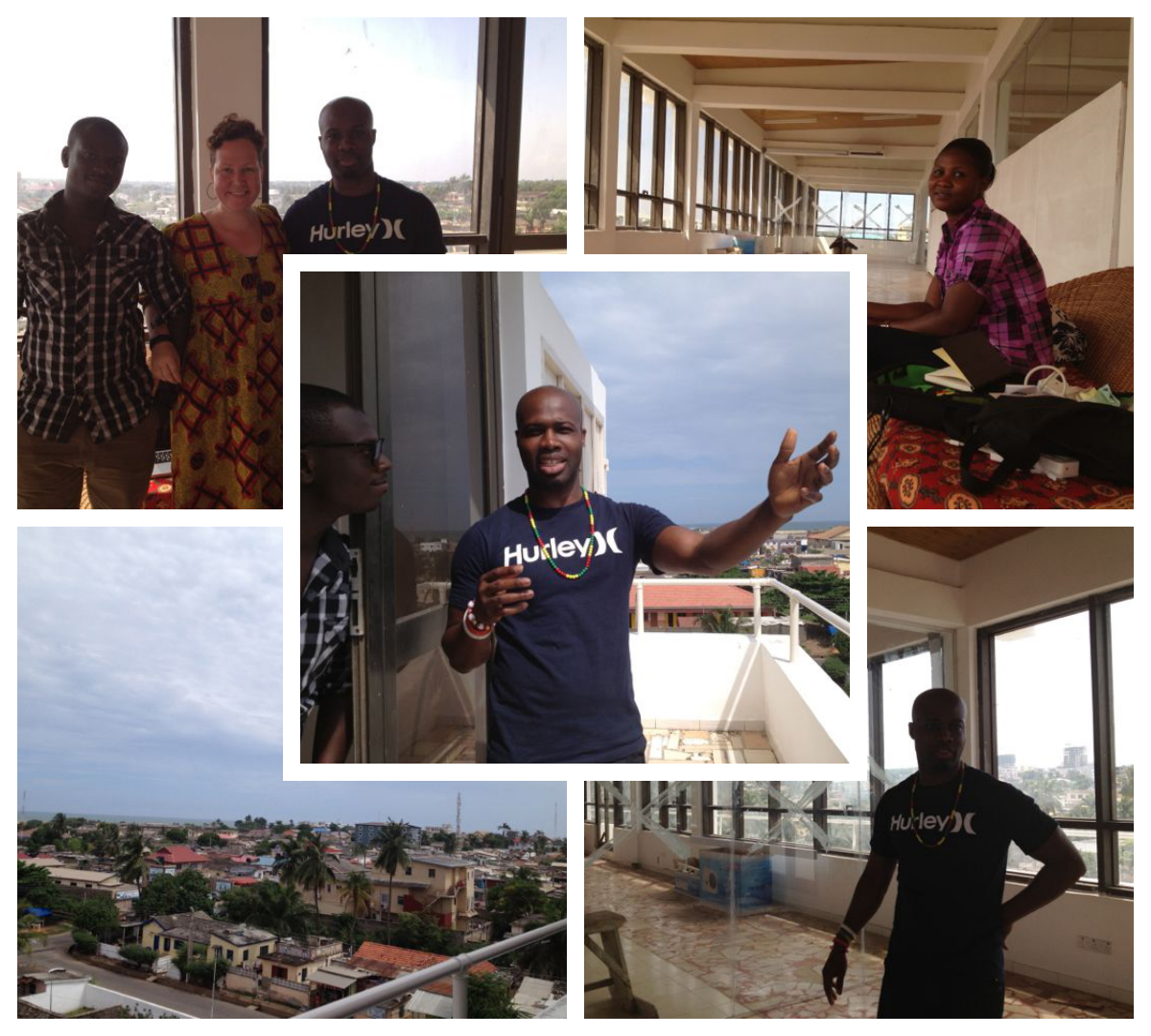
iSpace collage

Clockwise from “noon”: a view of the full space with assistant Dorcas at the front, Josiah at the conference room glass wall,  view(!), me flanked by the iSpace guys and in the middle Josiah describing the plan and Fiifi listening.

I walked away from our first meeting impressed by the vision (“in two years we have out-grown this space”) and the social concern (“we are doing this so that we can come together and solve Ghanaian issues”) and I can definitely see how BloggingGhana members can use this hub.

Eric Hersman, or White African as we know him, says about tech hubs in Africa:

“The tech hubs in Africa provide a home for those with new and innovative ideas, create an atmosphere where they are encouraged to try new things, and most importantly are able to meet like-minded individuals they can grow with.”

To sum up, iSpace is wonderful news for a community that is growing stronger by the day, but until now lacks a space to come together! 

Read also Edward Tagoe’s informative post on iSpace,  iSpace’s website  or Google+ page. Other African tech hubs are listed with AfricaHubs.

Continue Reading

You may also like

Hipsters in Ghana: Part 1

So, a Swedish friend of mine wrote an article about how politicians can learn from hipsters. For those of you who do not read Swedish, his argument was basically that even though hipsters might look silly and obsess over city farms, homemade bread and vintage clothing – they offer insights into sustainable living of the future. As I complimented hom on the interesting frame (learning from hipsters), he responded with a question: How is it with hipsters in Ghana?

Well, let’s back track and fist find a definition for hipsters. Urban Dictionary thinks it is:

 a subculture of men and women typically in their 20’s and 30’s that value independent thinking, counter-culture, progressive politics, an appreciation of art and indie-rock, creativity, intelligence, and witty banter.

So, are there hipsters in Ghana?

Hipster collage

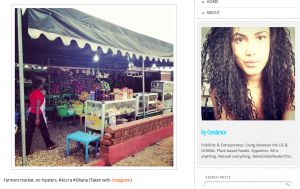
I guess that depends on who you ask. Candance (who recently moved to Ghana from the US) for instance recently commented that on Instagram that she was at a Ghanaian farmers’ market with NO HIPSTERS!

Screen Shot 2013-06-03 at 12.54.59 PM

But that might just have been due to language. That market likely wasn’t called a “farmers’ market”. And how will then hipsters know it’s a place for them?

But when used clothes are called “Vintage”  as well as when social media is discussed, hipsters do show up, also in Ghana. The indie scene in Ghana, in my humble opinion, is flourishing with TEDx events (read about TEDxOsu here from just this past weekend), AccraDotAlt’s TalkPartis (and check out these great hipster photos!) and Jungle Music Festival Asabaako where the Ghanaian hipster community discuss art, listen to local DJs play indie music and eat local foods. However, the best place to spot hipsters in Accra is at The Republic Bar, where local spirits blended into great cocktails meet nostalgic decor. Does it get more hipsterish?

Yes, the hipster scene in Ghana might be small, foreign inspired and sometimes elitist, but I think  – just like my Swedish friend – we can learn a thing or two from hipsters and their obsessions (for instance The Republic Bar manages to have the best AND cheapest cocktails in town as they use local ingredients).

What did I forget about the hipster scene in Ghana? I will gather your comments and write a follow up post as soon as my homemade bread has risen. 

Photo collage trying to prove my point with photos from Facebook groups for Vintage Gh and BloggingGhana.


Continue Reading

You may also like

Frontline Follow-Up: Are You Still A TV-Star?

The other day, as I was at the Data Bootcamp, my phone rang with a Swedish number showing. It does not happen often, so I left the meeting room and when I picked up the phone, Gustav Asplund from Swedish national radio was on the line. He told me the program was following up with people they had interviewed and asked me simply: last time you were a TV-host, how did it go and what are you doing now?

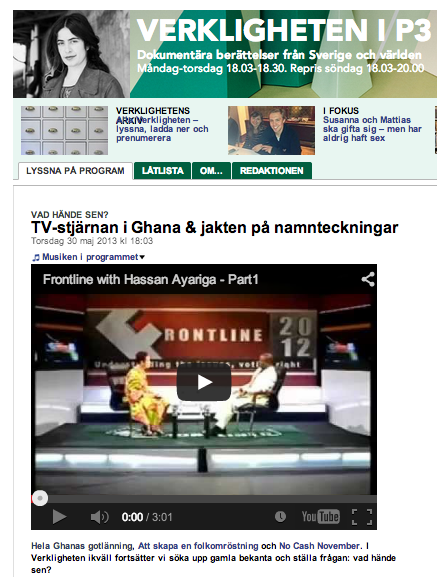
Screen Shot 2013-05-30 at 6.20.11 PM

This afternoon the program was broadcast and the pic above is from their website – headline “The TV-star in Ghana”.

Listen to the interview (only in Swedish!) here, forward to 22.48 to hear only my segment.

Continue Reading

You may also like

Data Bootcamp Day 1

Today at the Data Bootcamp I have learned:

  • about Internet in 5 years (yes, we  will all be wearing computer goggles A la Google Glasses)
  • what “extractive industries” really mean (oil, mining, timber and fish! that is resources you extract).
  • that data is not all about technology, the good old 5w and H is data!
  • to remember impact when choosing a project
  • where to find data, for instance the Worldbank, UN, AFDB, Google Public Data but I believe they forgot Gapminder!
  • That there is a Facebook for the extractive sector called GOXI.
  • that even though government contracts are often not available to the public, some of that information can be found with stock exchanges, company websites and export credit and investment facilities, basically anywhere where companies communicate with their investors.
  • that someone who knows nothing about programming can create interactive maps with the help of amazing program Fusion Tables.

On top of that I have also met some really cool folks – journalists, activists, developers and inbetweens –  and started thinking about two, maybe three apps/websites/data interfaces/crowdsourcing possibilities (ehm, yes as you can hear not exactly crystallized yet!) that can change Ghana!

All in all a great first day! 


Continue Reading

You may also like

African Union Day and Data Bootcamp in Ghana

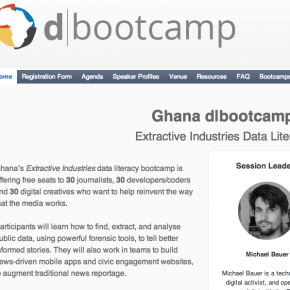
Screen Shot 2013-05-26 at 10.04.00 PMThis weekend is Memorial Day (US), Mother’s Day (Sweden, Hurray for mom!) and African Union weekend (Africa). But how does one celebrate the African Union? I am not sure, but will spend the delayed holiday (in Ghana holidays that fall on weekends get “compensated” at the first possible weekday, in this case AU Day fell on Saturday 25 May, hence tomorrow, Monday 27th is the day off!) and two more days at a data bootcamp vamping up my data mining skills, maybe they can be beneficial for the continent?
Normally, I stay away from everything bootcampey as endurance is not my strongest side, I rather like to digest information slowly over time, but I have made this exception as I am very much interested in how data can become news and more people can get access to knowledge. Or is the words of the organizers:

“to boost analytical, evidence-based reportage by giving journalists the digital tools, access to data, and computational skills necessary for transforming the way that newsrooms function.”

We will learn how to “mine” and “scrape” data, how to build apps and websites to visualize the data and how to “pitch” ideas as to get funding. Teachers are a list of interesting people from techie/journalist Justin Arenstein that I have earlier met at a Google event to the Worldbank statistician Lynne Henderson and many more interesting folks.

I am excited about tomorrow and should probably hop to bed. Already, I have some ideas for apps that might not necessarily conform with the “extractive sector” that is a focus of this workshop and a hanging question: where does academia come into all of this?

Behind this data bootcamp is the African Media Initiative, the World Bank Institute, Google Africa and theOpen Institute. Thank you!

Continue Reading

You may also like

25 Questions on Entrepreneurship

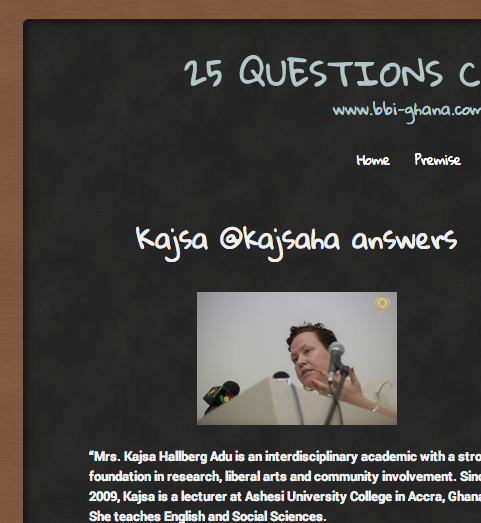
Screen Shot 2013-05-24 at 10.55.17 PMMy blogging friend Kobbie has started a project asking people in Ghana tech / entrepreneurial / life questions such as What does the internet mean to you? (Q2),  What’s the biggest thing you struggle with as an entrepreneur? (Q 11) and What does seeing the world mean to you? (Q 15).
You can read my 25 answers here, however here is a preview:

“12.  What’s the strangest thing you’ve ever done as an entrepreneur?  Bought 200 bananas.”

Edward, Ato and Rodney are other participants.

Continue Reading

You may also like

Running a Marathon OR At Home with a Two-Year-Old

Being at home all day with a two-year-old is similar to running a marathon.

She sets off into any direction and fast! She has a flair for dangerous things (electronics, sharp objects, vases filled with water…) and as soon as you do not pay attention she might have thrown all textiles in the house into the water-filled zink or emptied her lunch plate into a paper suitcase (both has happened to me today!) Before you even have time to get angry she is on a different project. She laughs and dances, sings and claps.

And then off again. Where is she now? Gotta run!

Continue Reading

You may also like

The Power of a Thank You Note

Today I had a busy day that was marred with the everyday difficulties of professional life in Ghana – first AC not working, then light off and AC and Internet not working and the battery slowly dying on my laptop…and finally  – light is back! –  but now Internet is not working! I wanted to cry. But instead I opened this envelope my colleague Kobina had given to me earlier in the day.

It contained a beautiful card with a little bird on it and inside a thank you note.

Immediately, my mood changed from deeply sour to quite happy – after all something I had done had influenced another person to the point of writing me a note to say thank you!

It reminded me of the wonderful story told by my new boss Dr. Marcia Grant  as part of giving a commencement speech at her Alma Mater, Swarthmore College, in 2007:

“It began in the spring of 1999. I was asked to visit Princess Lolwah al Faisal in Jeddah, as part of a team of senior academic administrators, to see how we could help start a liberal arts college for women, the first institution of its kind in Saudi Arabia. After our visit, we submitted a 20-page proposal, with important-sounding recommendations, and a five-year implementation time-line – and it was rejected!

I felt disconsolate, as I knew intuitively that I had the skill-set that the Faisal Family needed to establish Effat College. So I did what my mother had always taught me: I wrote a thank you note. In a single page I drew up my vision of the college. What I learned later was that there was no one in Jeddah qualified to interpret the jargon in our first official proposal, but that my simple thank you note showed my willingness to help the Princess.”

Fittingly, Grant ended her speech with encouraging the graduates to remember to write their thank you notes. That is excellent advice. However, in addition to that, I’d hereby like to encourage my readers to respond to the thank you notes you get and tell the writers of those notes how your day was turned around because of their thoughtfulness. Or as my mother-in-law often says:

“Thank you for thanking me!”

Continue Reading

You may also like

EVENT: I Luv Africa Filmfestival

Catch the free independent I Luv Africa Film Festival (ILAFF) in Accra!

Opening Night/Day One: May 17, 2013
Short Film Screening Series & RWUL Film Q&A
7pm-9pm Location: Goethe-Institut in Accra Ghana
*Opening Night Afterparty @ Reggie Rockstone’s Office-Grand Pappaz Free Entry with ILAFF 2013 Pass

Day Two: May 18, 2013
Film Workshops & Special Screening of “Soul Food Junkies ” 1-4pm Location: AUCC in Accra
Feature Film Screening Nairobi Half Life” 6pm-8pm Location: Goethe-Institut in Accra

Day Three: May 19, 2013
Google+ Hangout Online Chat with Filmmakers
Community Art Project with Attukwei Art Foundation 4-6pm Accra

Read more on organizer RWUL and the ILAFF.

Continue Reading

You may also like

Ghana’s Most Important Issue via The Maternal Health Channel

A wonderful initiative by Creative Storm is the Maternal Health Channel on GTV on Thursdays at 8PM and on TV3 on Fridays at 8.30 PM. The program sheds light on maternal health in Ghana, or rather the lack of it.

The series started with the story of Charity, a woman who did not survive giving birth.

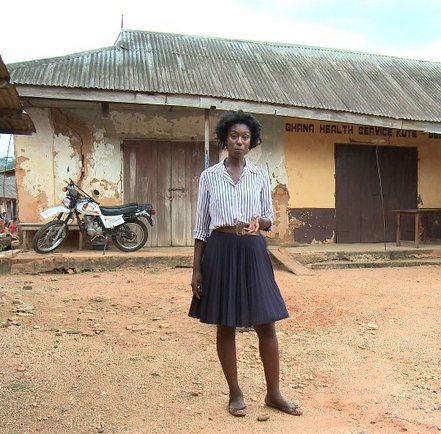
Maternal Health Channel host Ivy in front of the government clinic in Kute Buem.

MHC write on their very active Facebook page:

“Every maternal death is an intensely personal tragedy and it is essential to hear the stories of those who have suffered in order to illuminate an issue that is both immediate and far more complex than it seems on the surface.
We can change; Ghana can achieve Millennium Development Goal #5, the reduction of maternal mortality by 75% in the year 2015. The first step is EVERYONE having a discussion about an epidemic that is far too often overlooked. The first step is with YOU.”

As a mother and a daughter and a citizen of the world, it angers me terribly that women should have to give up their life when giving life. We know it takes 9 months, we know you need vitamins and clean water, we know giving birth is a risk and a hard job, we know how to create the best possible chances for both mother and baby to survive – still women are  dying for no good reason at all.

This week, they go to Kute Buem in the Volta region, see pic. 

Personally, I think The Maternal Health Channel is one of the most important media initiatives in Ghana I have ever seen. It is massive, well thought out and quite digital (facebook, vimeo, tumblr, on Twitter use hashtag #mhcghana). If you agree with my sentiments or, better yet, with their mission to save more mothers and babies in Ghana, please spread this information to your networks, discuss online, blog on it and watch the program!

I have written on this topic before Why Are Mothers Still Dying? and When I Donated Blood and Ganyobinaa also wrote about MHC.

Continue Reading

You may also like