
In our family, we speak three languages: English is the common language that all of us speak, then I speak Swedish with the kids (which my children’s father can understand some, but cannot speak it), and the children’s father speaks Fanti, an Akan language ( which I only have a basic level of understanding and proficiency) with them. People around us speak either English or Fanti or other dialects of Akan, in school, my daughter is taught in English. We Skype with my Swedish family in Swedish maybe once a week.
Swedish is hence the language my children hear the least of.
My thoughts around teaching them my language are:
- It is extremely important to me they speak my mother-tongue. It is the lauguage in which I can express myself best and it is the carrier of my culture. My children speaking Swedish is non-negotiable and I am envisioning them speaking Swedish fluently as adults, on a level high enough it would not immediately be possible to tell they did not always live in Sweden.
- If I, their mother, speak Swedish, they will too. I therefore try and speak as much in Swedish with them as I can. Honestly, I constantly disappoint myself and end up speaking English much more than I intend to, but I try to be forgiving, switch to Swedish when I realize I am rattling on in English and say to myself that “tomorrow is a new day…”
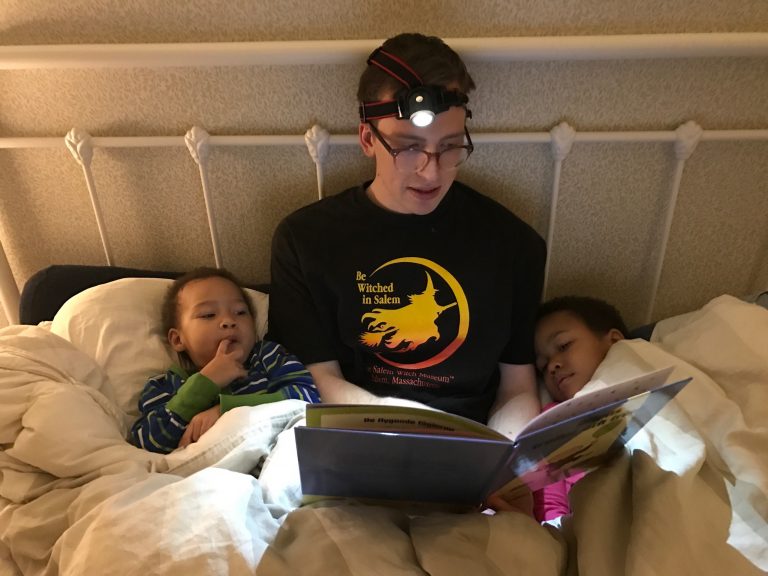
- To increase my children’s Swedish vocabulary, we read books every day. I try to read to them every night I am home for about 45 minutes (5 nights a week). We have many children’s’ books in Swedish, but I also do direct translations from books in English (and the one in French!). We also converse around pictures in the books.
- Mixing languages is ok. The Multilingual Children’s Association agrees and calls it “harmless and temporary”. If my children speak mixing English and Swedish, and they do that quite a bit, I might translate to Swedish in my response to them. For instance, they might say: “…and kaninen [the rabbit] fall down”, I can respond “Ja, den ramlade…” [Yes, it fell]. But I don’t want to coerce them into speaking Swedish as I don’t want there to be any ill-feeling towards the language. At times that means I will be speaking Swedish and they will respond in English. Good enough.
- We spend at least one month in a Swedish-speaking environment every year. I think it is sometimes good to be emersed in the language and “forced” to speak (but I am not contradicting myself, the force that comes naturally from speaking to someone who prefers Swedish is very different to be made to speak to someone who speaks both languages).
- I take help from technology. When my children play iPad games or watch movies, I make sure some of them are in Swedish. It is also a great way of adding the cultural aspect of life in Sweden such as current favorites Barnen i Bullerbyn and Astrid får en lillebror.
- I think of next steps. However, I realize my children lack some specific vocabulary, for instance, words for play in Swedish (My child: “Hello, let’s play HIDE AND SEEK”, Swedish child: *blank face*), so I would love to organize playdates for them with Swedish speaking children. I know a few here in Ghana and am aware of a Swedish family moving to our town soon. Likely my Swedish would improve with some more practice as well!
If you have experiences with a multilingual life, I would love to hear your story!
Thanks to Charlie’s comment and Nadja’s facebook post which inspired this post!
This post is part of a series of posts about parenting.

 This week I read: